Petit Verdot Signature 2023
*** Enter the Description of this product
Although Petit Verdot is rarely bottled as a stand-alone varietal, it is often present in the greatest vintages of Bordeaux blends. Used predominently for the backbone, structure and color, Petit Verdot is bold and rustic with ripe fruit characters and hearty tannins. Ironically, the variety, taste-wise, does not seem to fall in the same family as Cabernet and Merlot. Instead, Petit Verdot has almost Zinfandel-like characters, big-bodied with ripe brambly fruit. A quenticential blending component, Petit Verdot adds an essence to Bordeaux blends that no other variety can.
2023 Vintage
Ripe blackberries immediately dominate the aromas with maybe a note of the black currant and subtle baking spices. This full-bodied expression still has all the balancing acid from it's mountain-grown roots. More wild blackberry and dark cherry flood the palate while rounded (yet still there) tannins provide the wonderful structure. Perfect wiht a rib-eye steak or rich fare!
| Vintage | 2023 |
| Varietal | Petit Verdot |
| Appellation | El Dorado |
| Vineyard | Enye Vineyards |
| Designation | Estate Grown |
| Sugar | 0.15% RS |
| Acid | 0.57g/100ml |
| PH | 3.72 pH |
| Aging | 19 months in neutral oak barrels |
| Fermentation | 10 days on skins in an open top fermenter, punched-down twice daily |
| Alcohol | 13.50% |
| Volume | 750 ml |
| Bottling Date | 03/10/2025 |
| Cases Produced | 72 Cases |
The original small planting (0.33 acres) of Petit Verdot was grafted in 1992 on to Sauvignon Blanc rootstock in our Enye Vineyards in Pleasant Valley. With a north-facing slope at 2,800 feet elevation, the climate is cool, providing for a slow maturation of fruit. Often the latest variety we pick, our Petit Verdot is very small-berried with incredible density and richness. The single-wire trellising system aided by copious amounts of hand leaf-thinning allows for an open canopy and balanced fruit.
In 1997, we planted an additional 0.26 acres on the same slope with a vertical-shoot-positioned system on the divigorating rootstock 101-14. Equally intense and dense, this young block is field-blended with the original block for complexity.
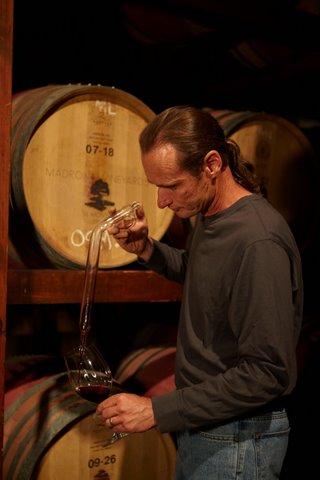 Paul Bush, Owner/Winemaker
Madroña Vineyards
Camino, California.
We are a family-owned and operated winery focusing on terroir-driven, Estate-Grown fruit.
Annual Case Production: 12,000 cases
Planted Acres: 70 acres planted at the 2,850 to 3,000 foot elevation.
Career Background: Having helped plant the family vineyards as a kid in 1973, I grew up working in our winery what seemed like every day after school. I had no intention of “winding up” in the wine industry and graduated from U.C. Davis in 1989 with a degree in Economics. However, with an interest in traveling abroad, our winery offered a flexible schedule and an opportunity to work with inspiring winemakers such as Mark Foster and Hugh Chappelle. I began managing the vineyards and business in 1991 and making the wines in late 2002.
Biggest Professional Challenge: Balance! Working with my wife, Maggie, we find our greatest challenge is how to be business owners with all of its responsibilities while making the wines, growing the grapes, marketing the brand and raising two daughters. Any given day can be filled with dusting the vineyards at daybreak, acid trials before lunch, working in the tasting room in the afternoon—and then throw in a swim meet or school play for spice. Undoubtedly, every small, family winery tackles the same aspect of wearing so many hats, but the challenge and excitement is unique to each one.
Varietals that Madroña is Known for: In total, we grow 27 varieties in our El Dorado vineyards. From within these plantings, however, I believe that Malbec, Cabernet Franc, Zinfandel, Riesling and the seven Portuguese varieties (for our New-World Port) are consistently outstanding.
Short Testimonial: I truly can’t imagine doing anything else but growing grapes and enjoying wine. I believe the terroir of our region is unique with overall cool-climate aspects, peppered with warm summer days and a slightly shorter growing season. So finding the true expression of each variety for our vineyards ends up being an exciting and challenging adventure every vintage. The wines have more backbone and structure than most regions of California while showcasing the intense varietal character of mountain fruit. Most often, I find that the wine knows best in how it should be “made,” and I’m just along for the ride. As we once heard in France, “One does not make wine. One elaborates wine!” And with our Estate-grown grapes, I am quite content to be the “elaborator.”

Click on the links below to get information about our
other vintages.
2023
2009
2009
